 Dineora


 Restaurant
 Location
 Cuisine
 Designed by Dineora
A Lebanese caterer in the market hall
JOOD presents itself as an “artisan Lebanese caterer”. It is located in the hall of the Saint-Germain market, in the Odéon neighborhood, in the sixth arrondissement of Paris, and the site says so from the start: “Paris · au cœur du marché”. People come for a cuisine of sharing: cold mezze such as hummus, moutabal or labneh, a fresh salted white cheese, and hot mezze such as falafel, kibbeh, cheese rikakat, sambousek with feta and mint or with spiced beef, the spinach turnover, batata harra or Lebanese rice with vermicelli.
The menu also includes grilled meats, taouk, kafta and jawaneh, marinated chicken wings, chicken or beef shawarma, sandwiches filled with hummus, garlic cream and pickles, and set meals. A Lebanese brunch platter brings together mini man’ouche with za’atar, foul moudammas, olives and a small omelet. To finish, baklava with pine nuts, cashews and pistachios, a Lebanese rahweh coffee, mint tea in a teapot or a tea with sweets.

The challenge: conveying sharing in the middle of a market
 The challenge: conveying sharing in the middle of a market
A caterer set up in a market hall lives amid the stalls, the counters and the foot traffic. The website therefore had to give an image of the place, warm and precise, and make clear what makes JOOD what it is: small plates you share, in the heart of the market.
The menu also had to stay readable despite its variety, from mezze to grills, from brunch to set meals and sandwiches. And it had to serve equally well the person who stops by to pick up their meal and the one who has it delivered.
An art direction between the hall and the mountain
 An art direction between the hall and the mountain
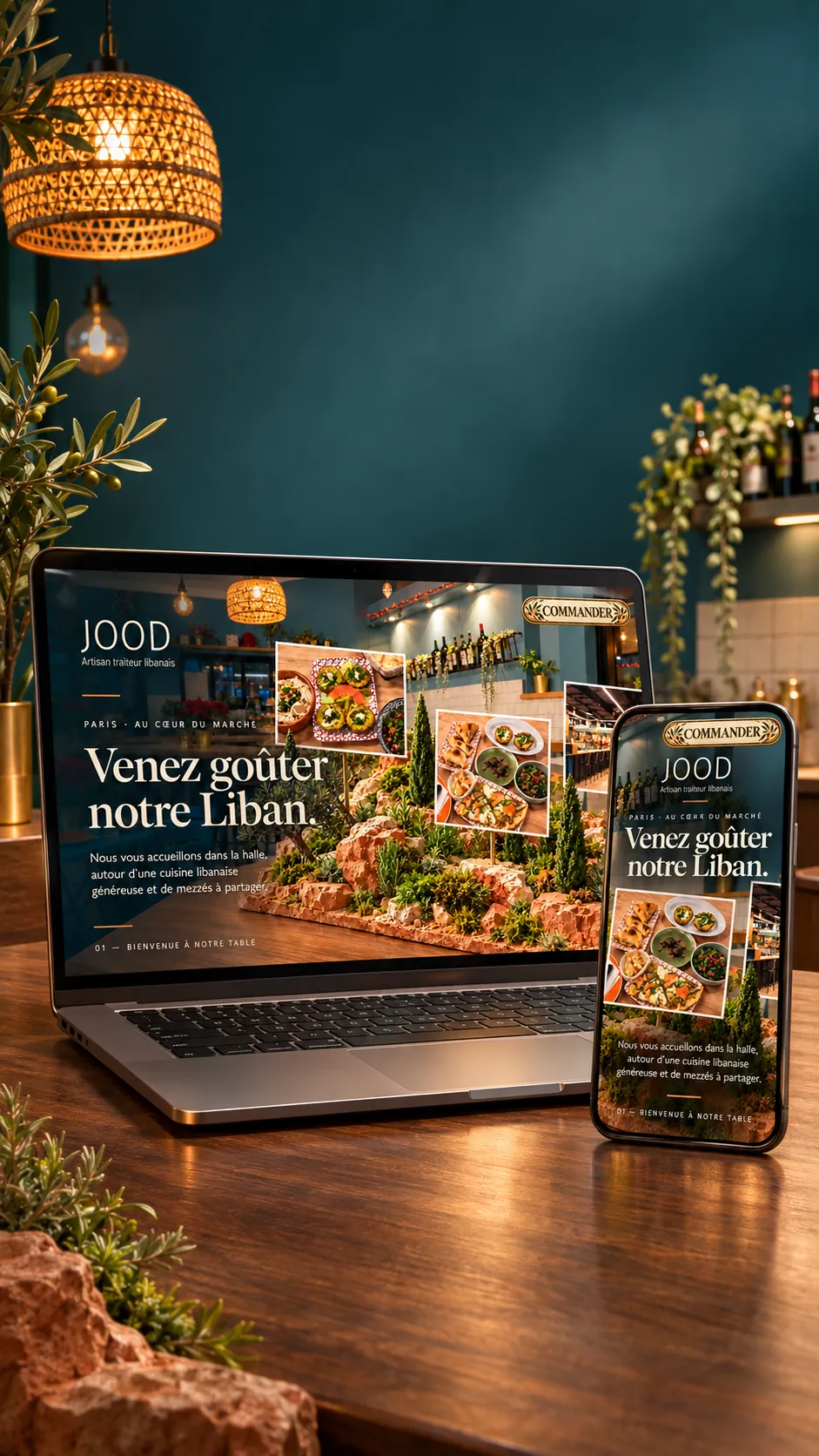
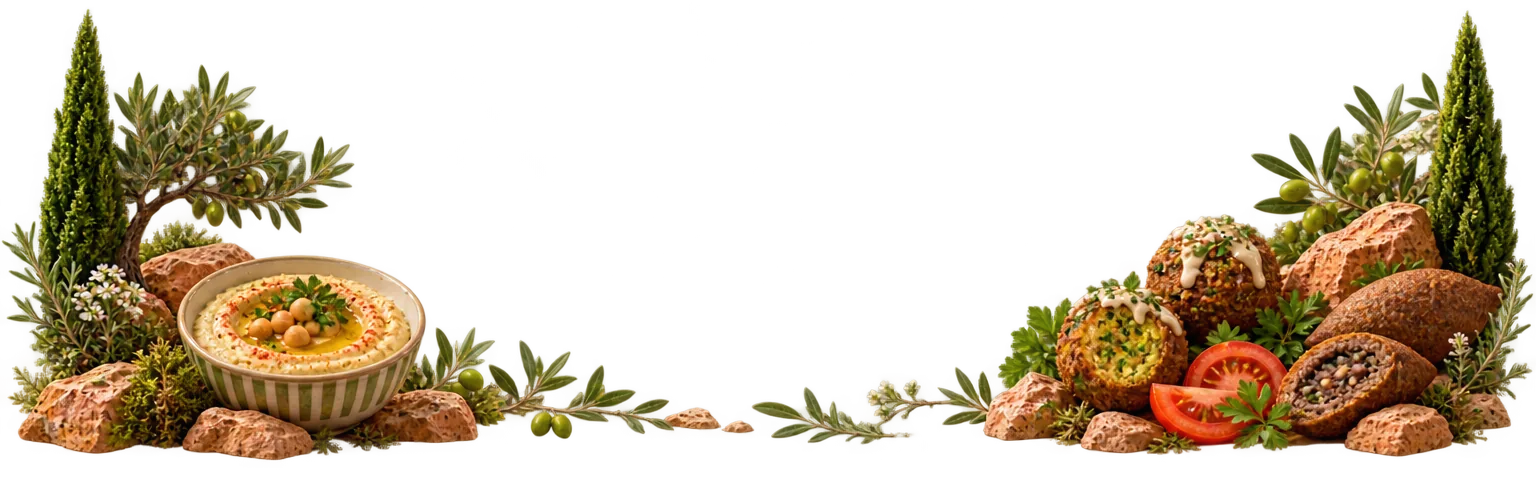
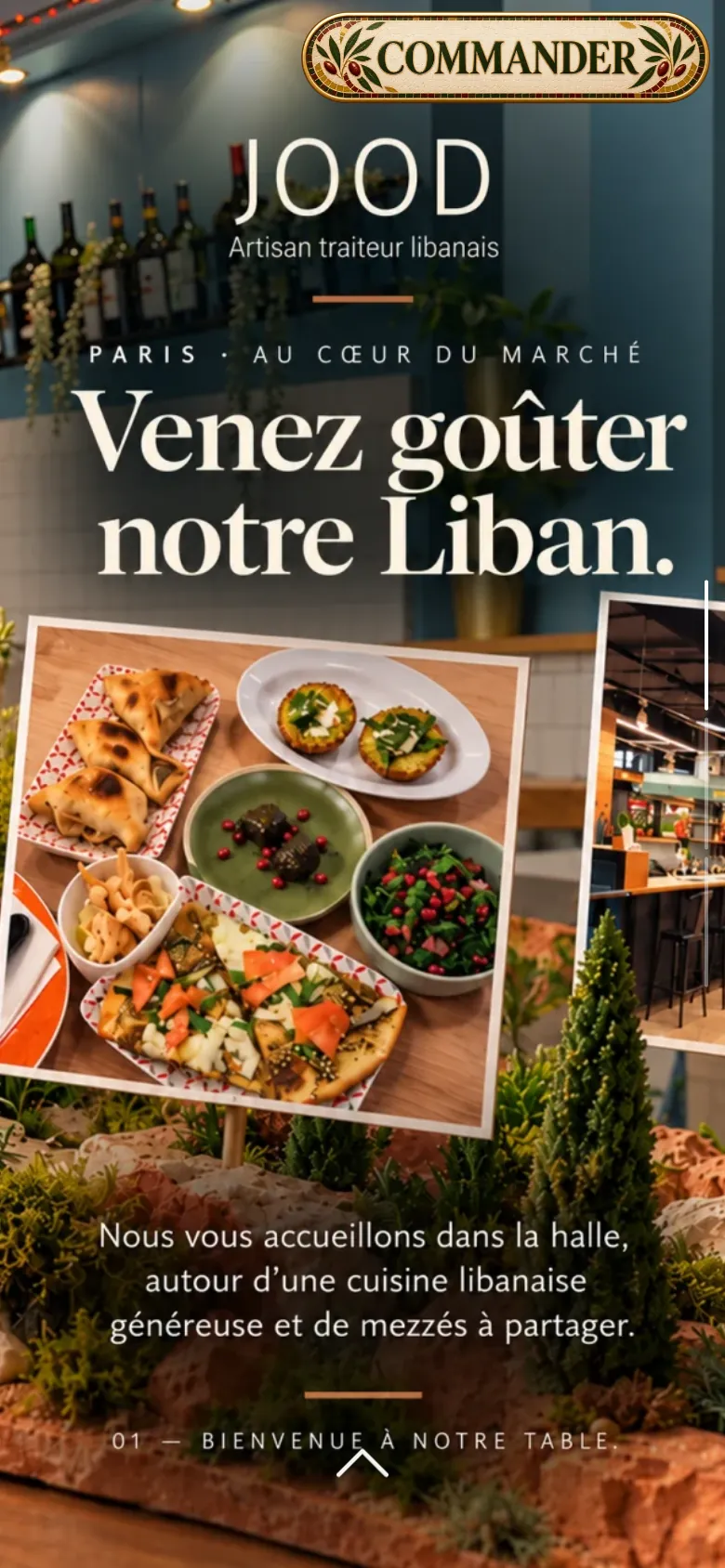
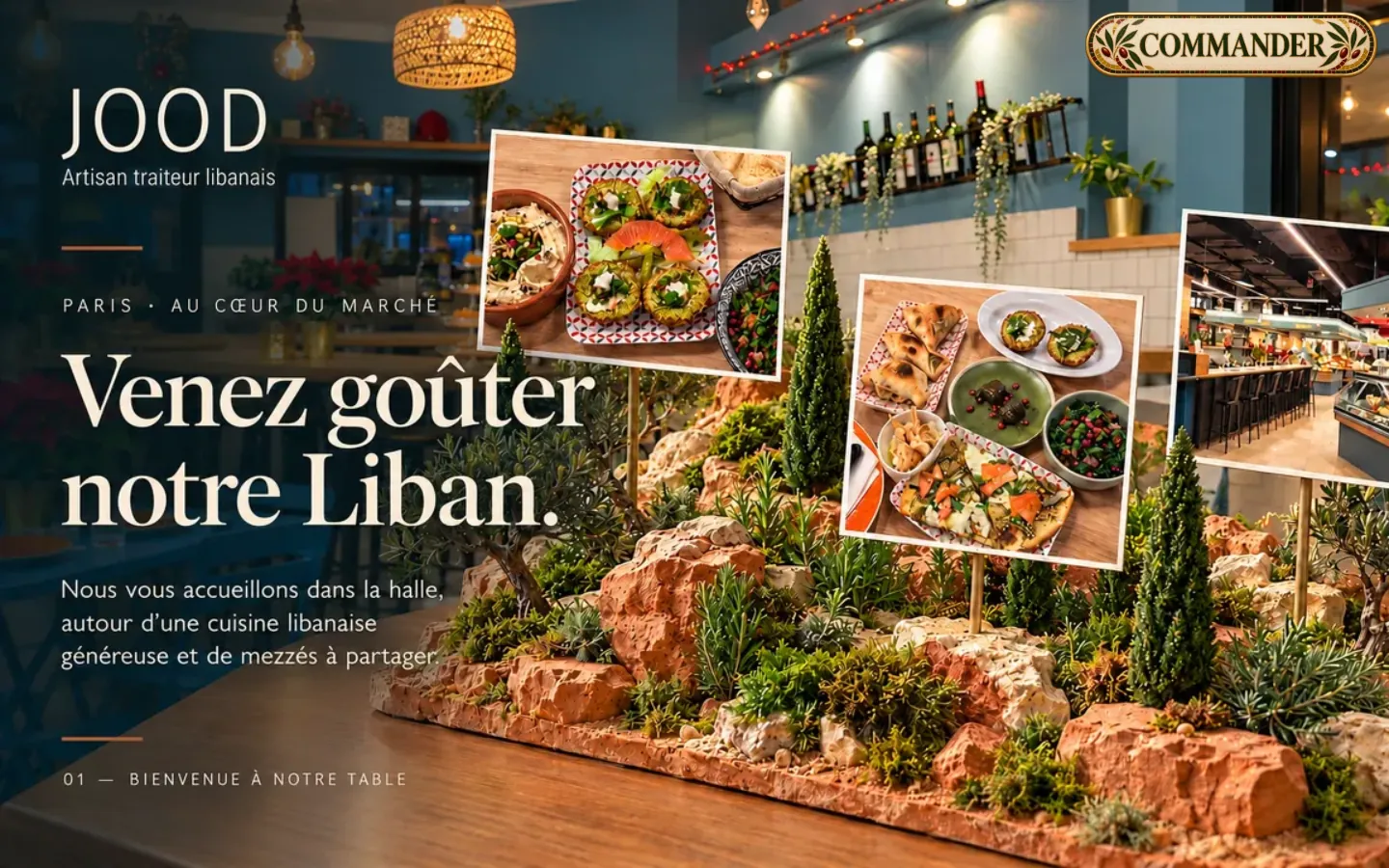
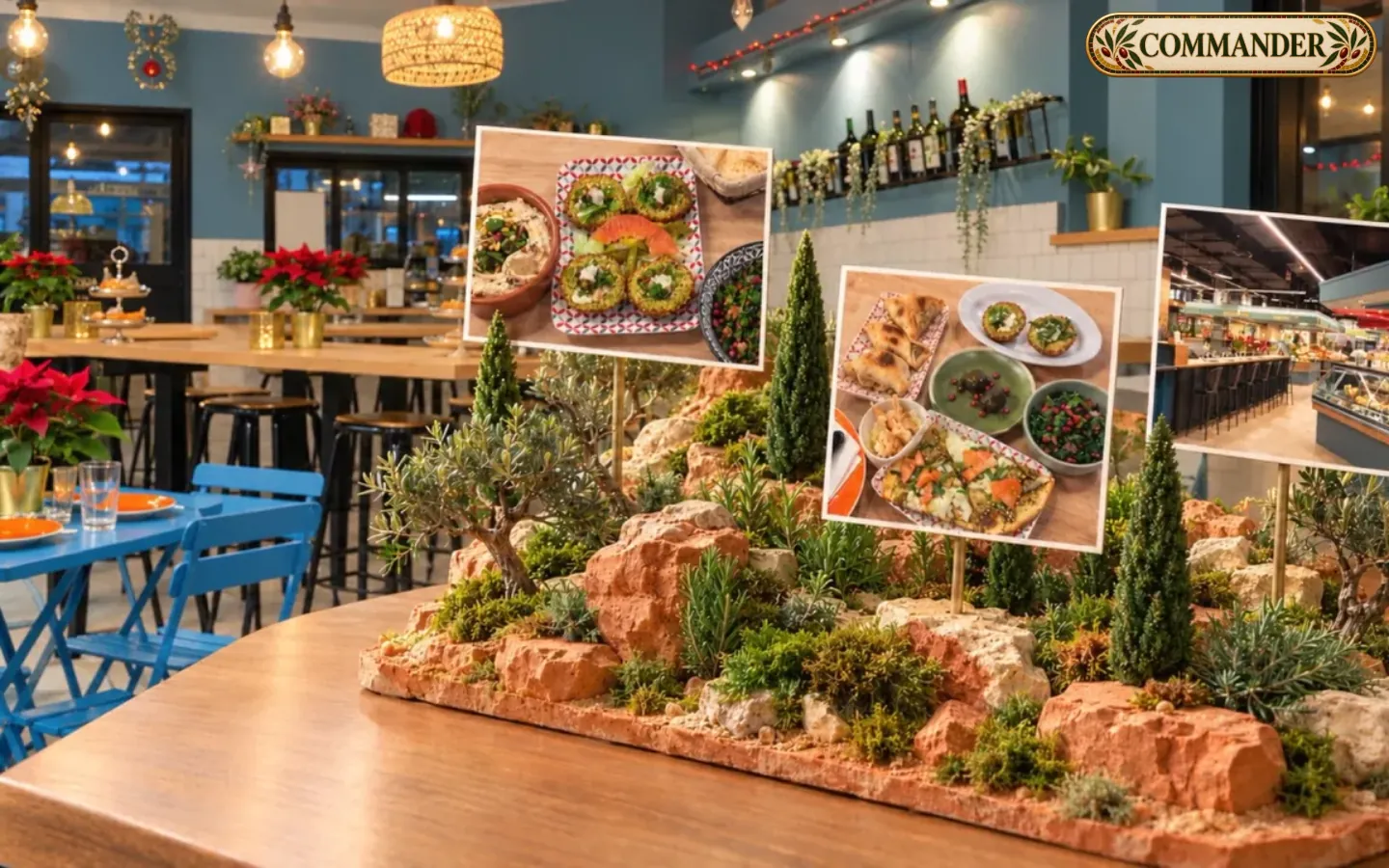
The palette blends the teal blue of the walls, the light wood of the tables, the terracotta of the plates and the green of the herbs. The visuals play on two registers. On one side, the hall: blue walls, white tiles, lined-up bottles, wicker pendant lamps, folding blue chairs, then a red counter lined with black stools in front of the fruit and vegetable stalls. On the other, a small landscape set on a wooden table, made of ocher rocks, cypresses, olive trees and rosemary, where scenes of mezze and of the hall stand like signboards.
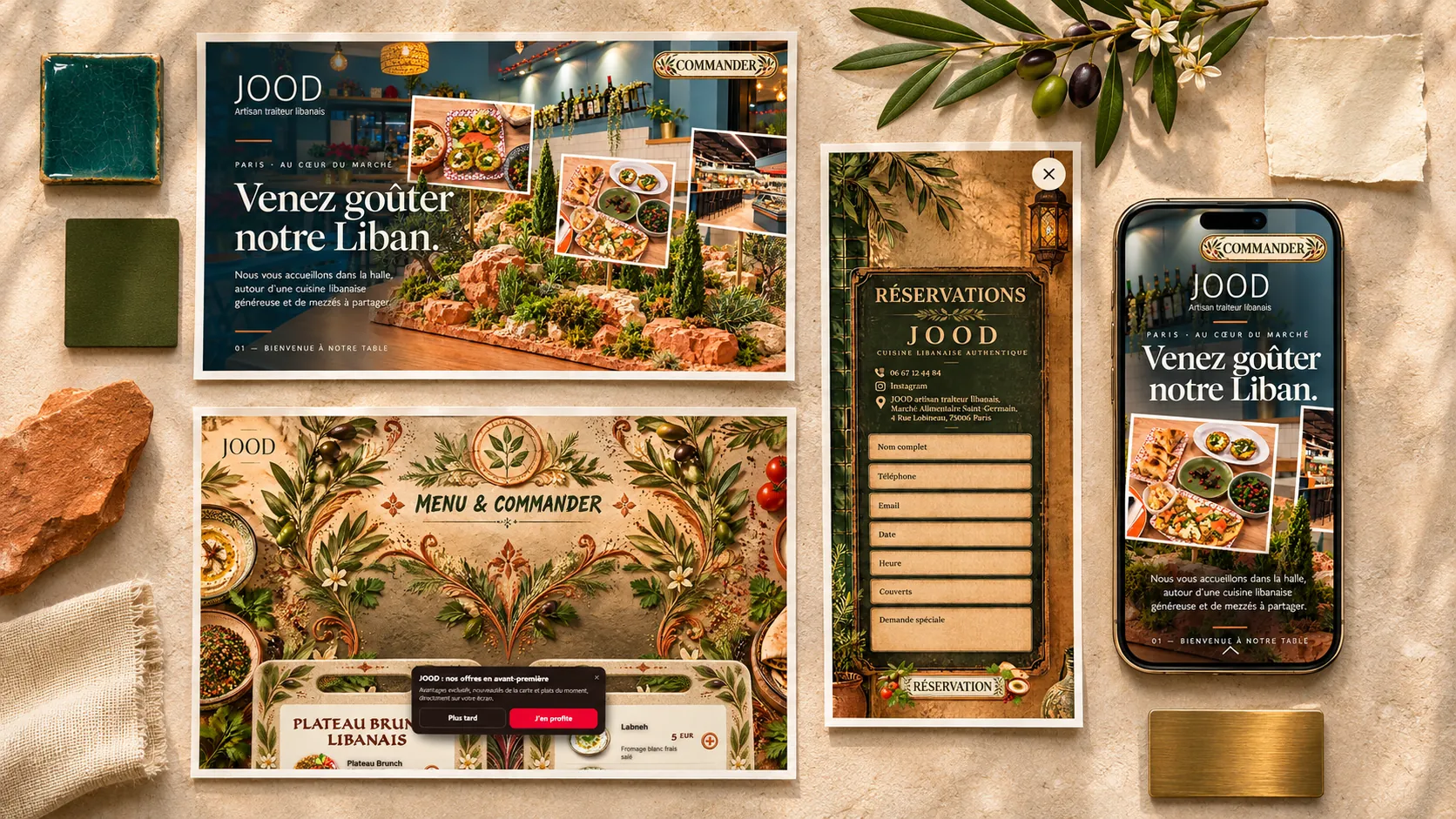
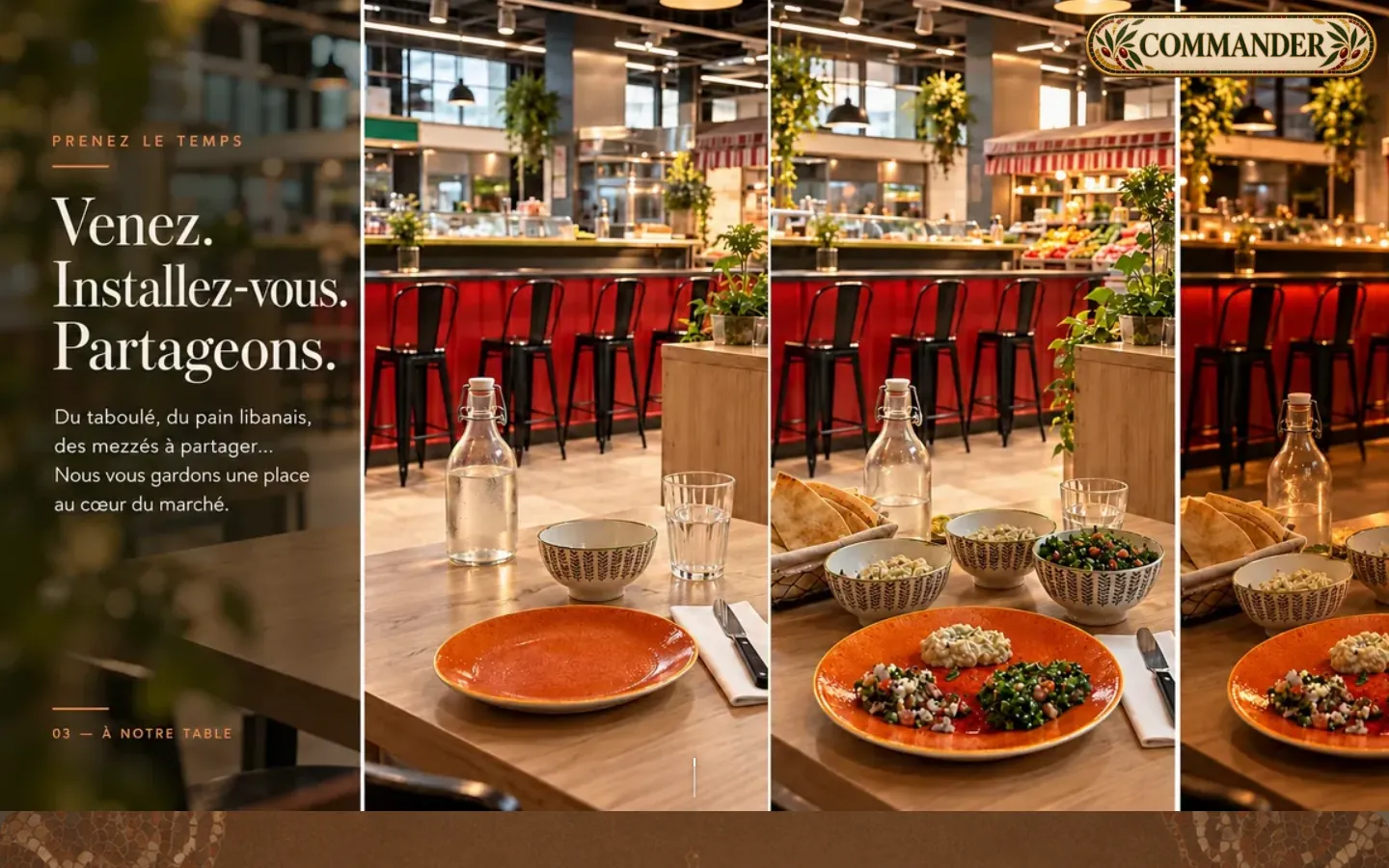
The headings are set in a typeface drawn from the letters of the logo: thin capitals that give the name JOOD a sober, elegant look. The Commander button is painted in the world of the place: a cream cartouche edged with mosaic, framed by olive branches, which stays at the top of the screen.

A home page that unrolls like a film
 A home page that unrolls like a film
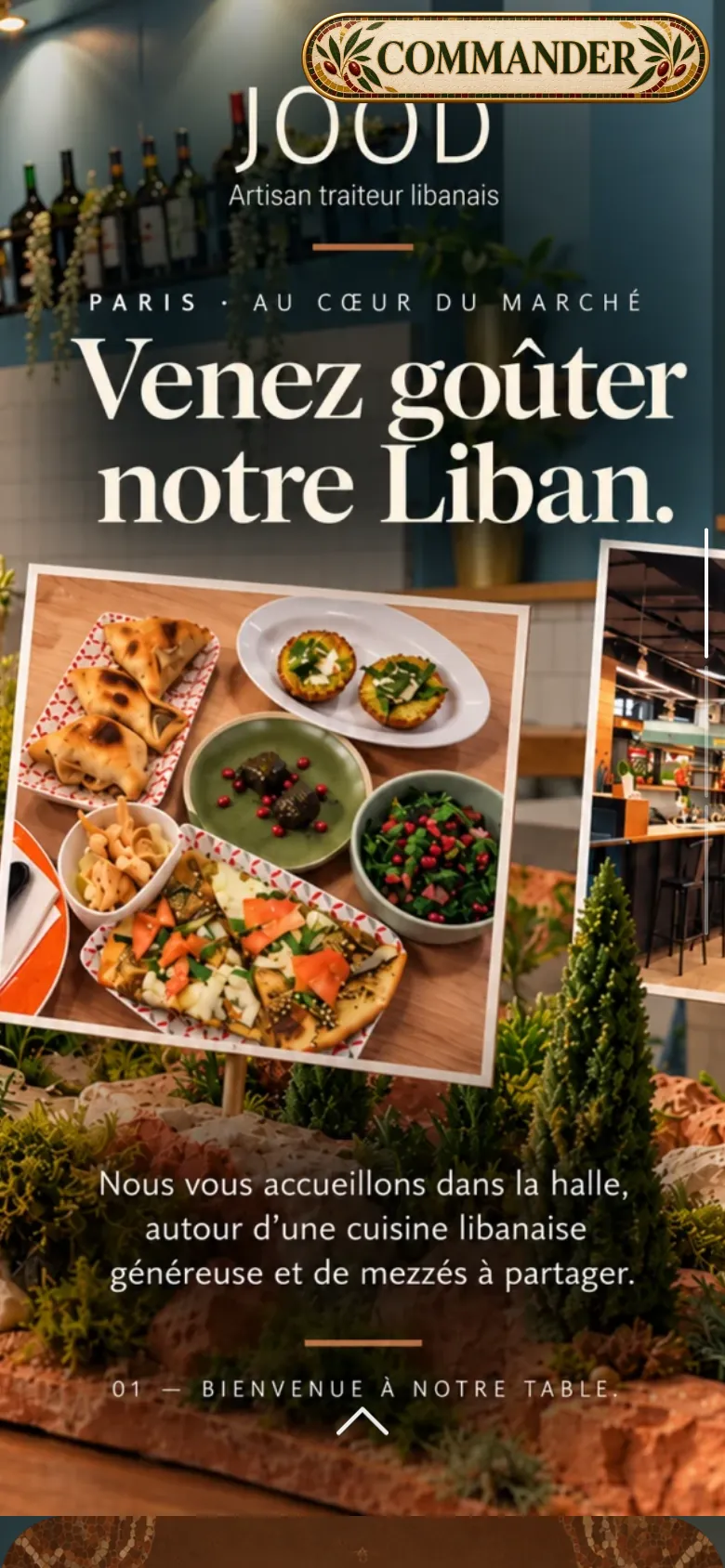
The home page is a film that advances as you scroll, in numbered chapters. The first, “Bienvenue à notre table”, sets the title “Venez goûter notre Liban.” above the small landscape of rocks and olive trees, with a welcoming sentence: “Nous vous accueillons dans la halle, autour d’une cuisine libanaise généreuse et de mezzés à partager.”
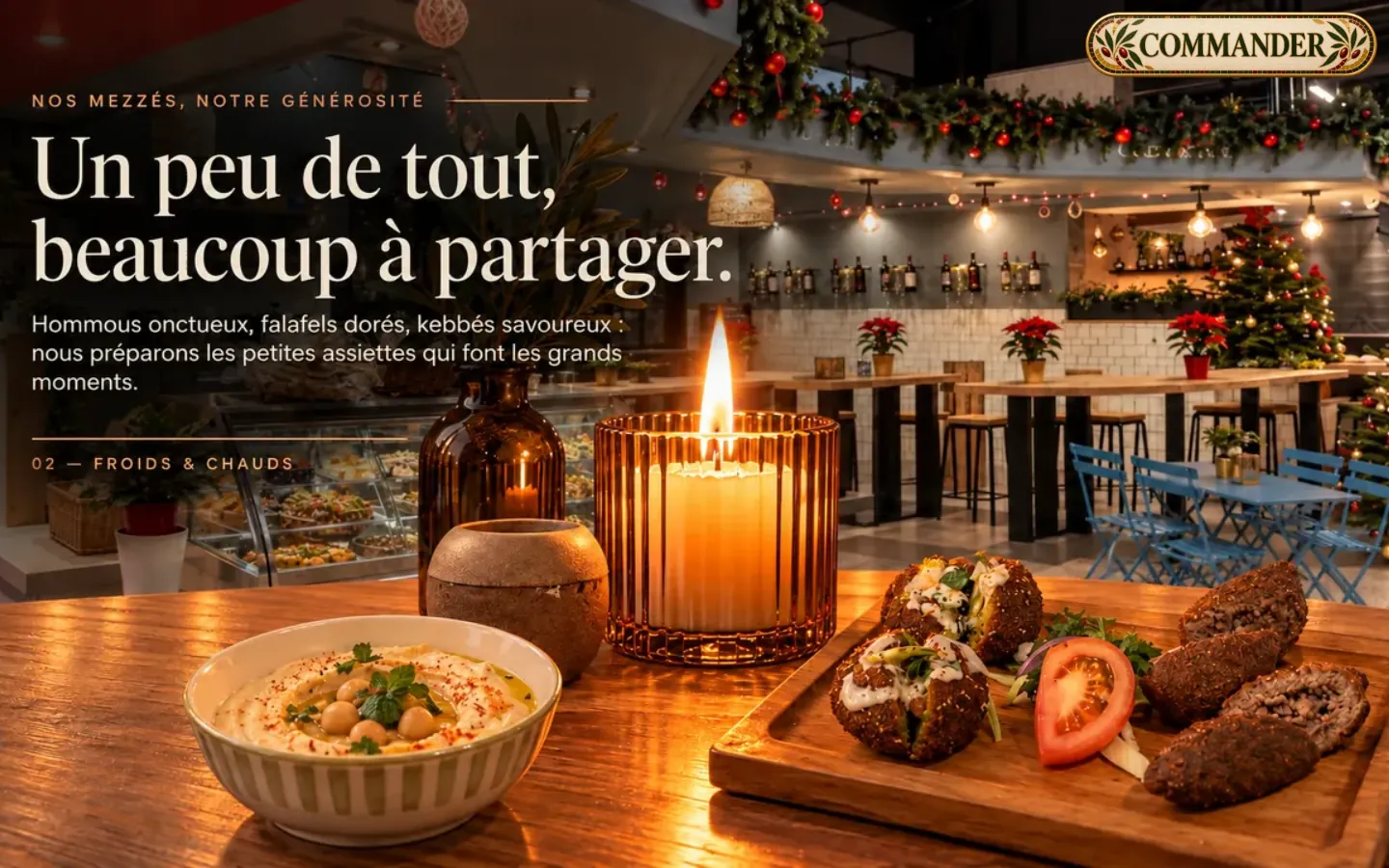
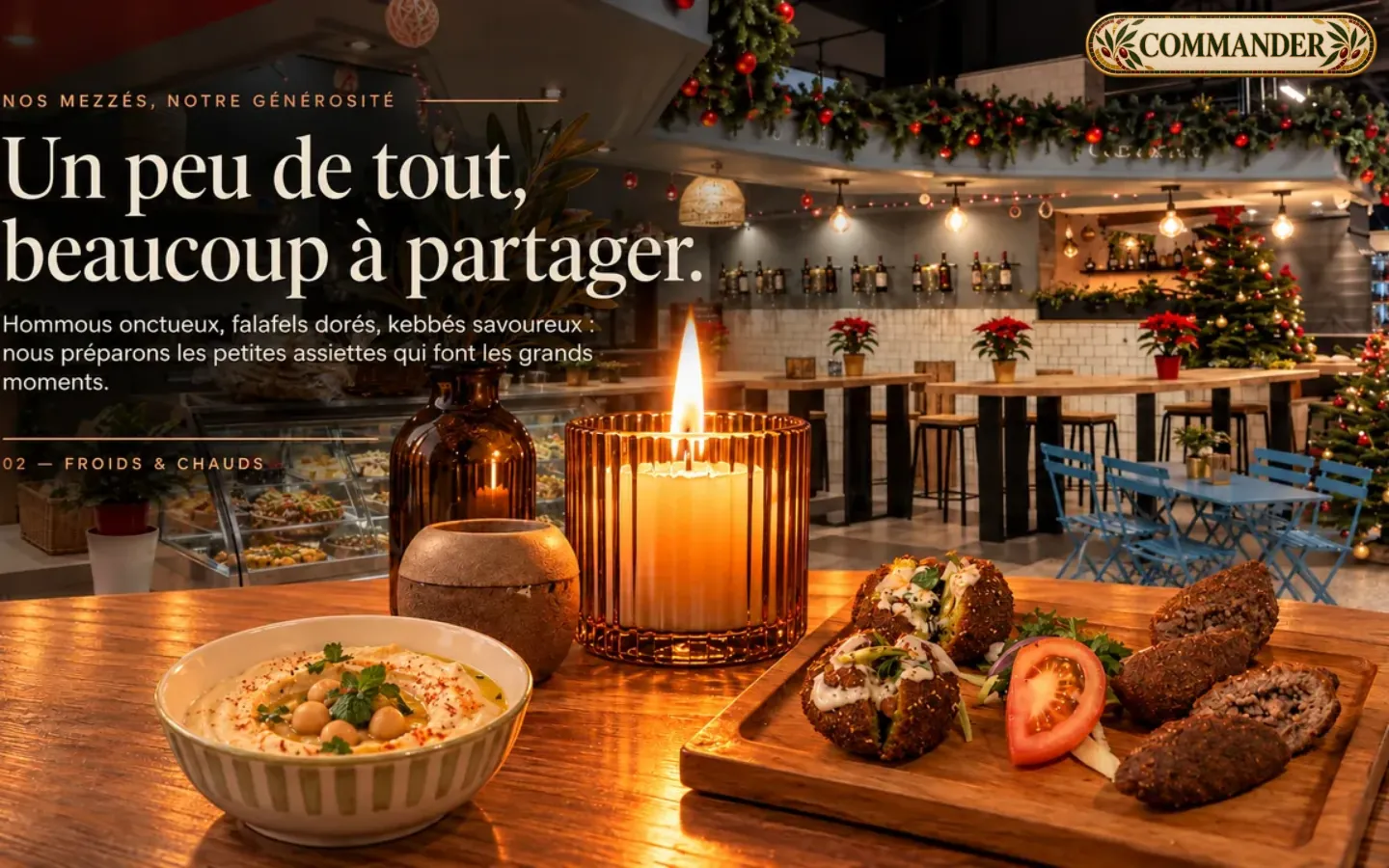
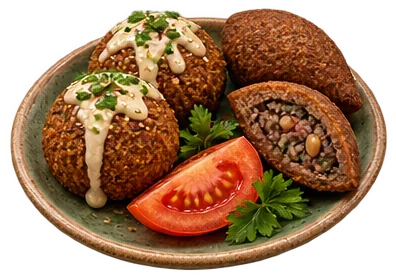
The second, “Froids & chauds”, opens on “Un peu de tout, beaucoup à partager.”: a bowl of chickpea hummus, a board of falafel and kibbeh and a lit candle, in front of a dining room decorated with garlands. The third, “À notre table”, unrolls three shots of the same table at the market counter, first empty, then laid with Lebanese bread, tabbouleh and mezze, under three words: “Venez. Installez-vous. Partageons.”
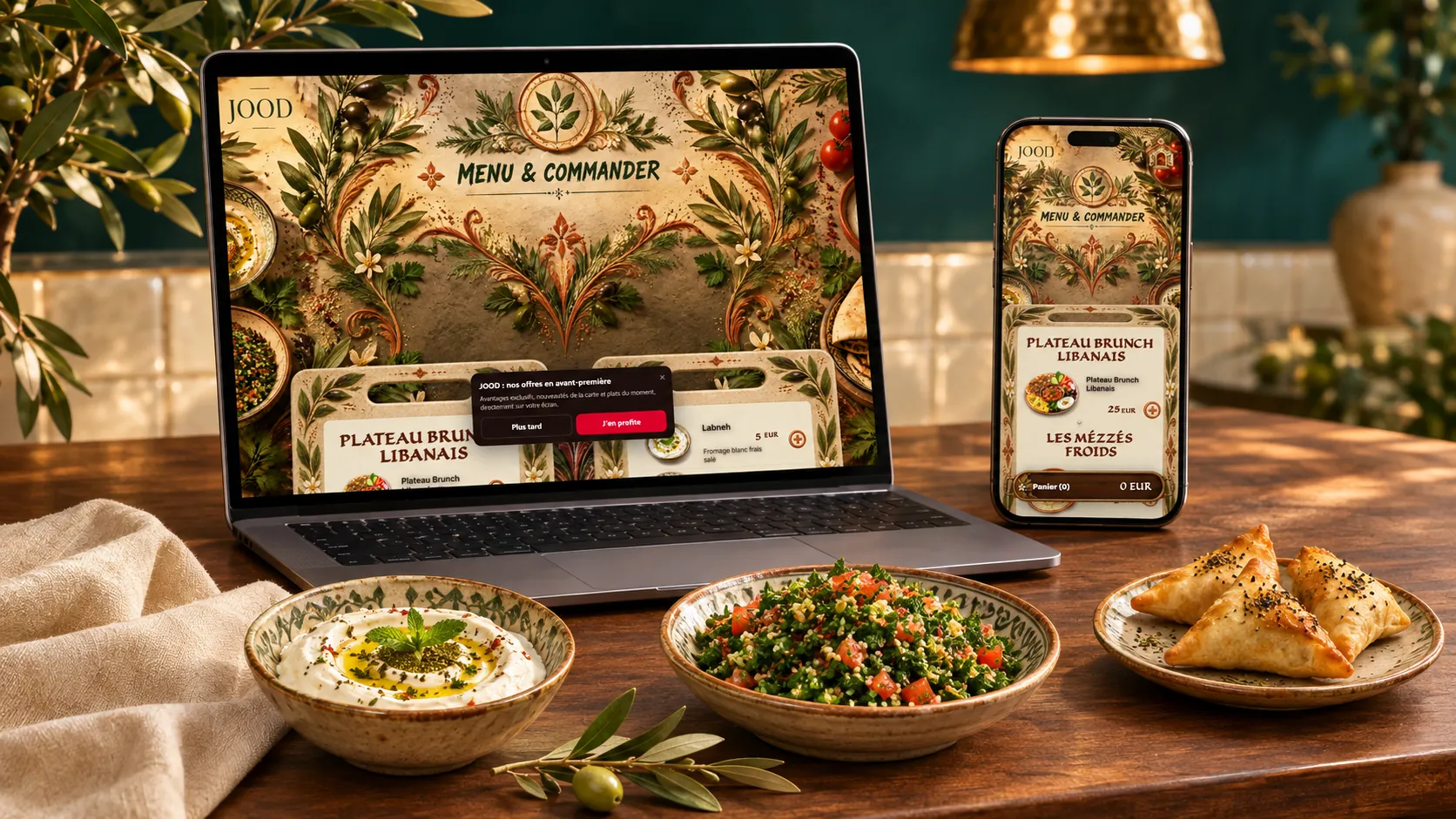
An online menu for takeaway or delivery
 An online menu for takeaway or delivery
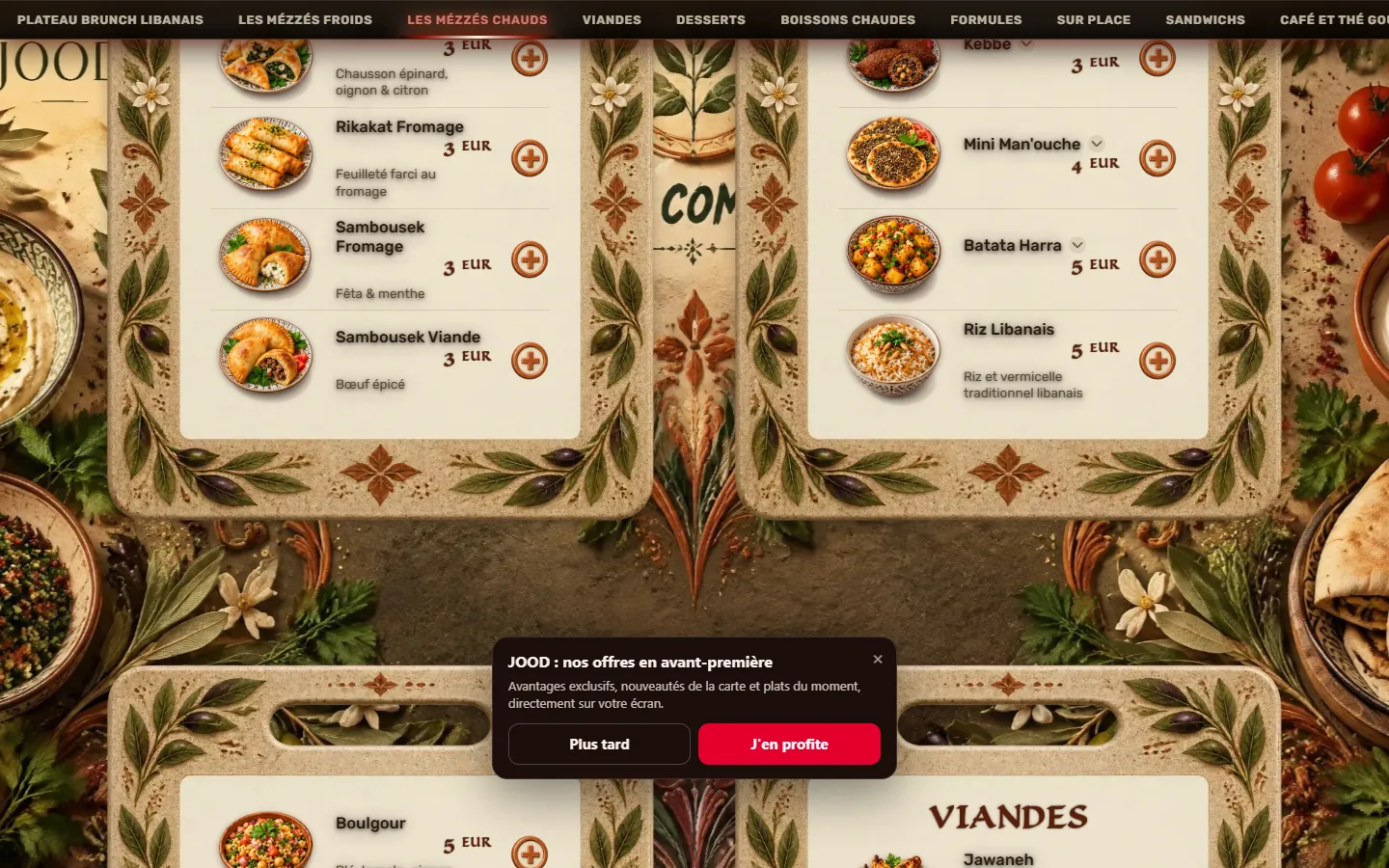
The ordering page leaves the hall for a setting of pale stone and sand, carved with terracotta-colored scrollwork and olive branches laden with olives, with white flowers, bowls of hummus and tabbouleh and folded bread along the edges. The title “Menu & Commander”, written in green with a brushstroke, is topped by a medallion where a branch grows. Each section sits in a stone frame engraved with foliage, with a burgundy title, and a bar at the top of the screen leads straight to brunch, cold or hot mezze, meats, desserts, set meals or sandwiches.
Each dish appears with its image, its name, its price and a short description, from the sambousek with feta to the Lebanese rice. The guest adds dishes to the cart with a terracotta button, then chooses to pick up the order or have it delivered.
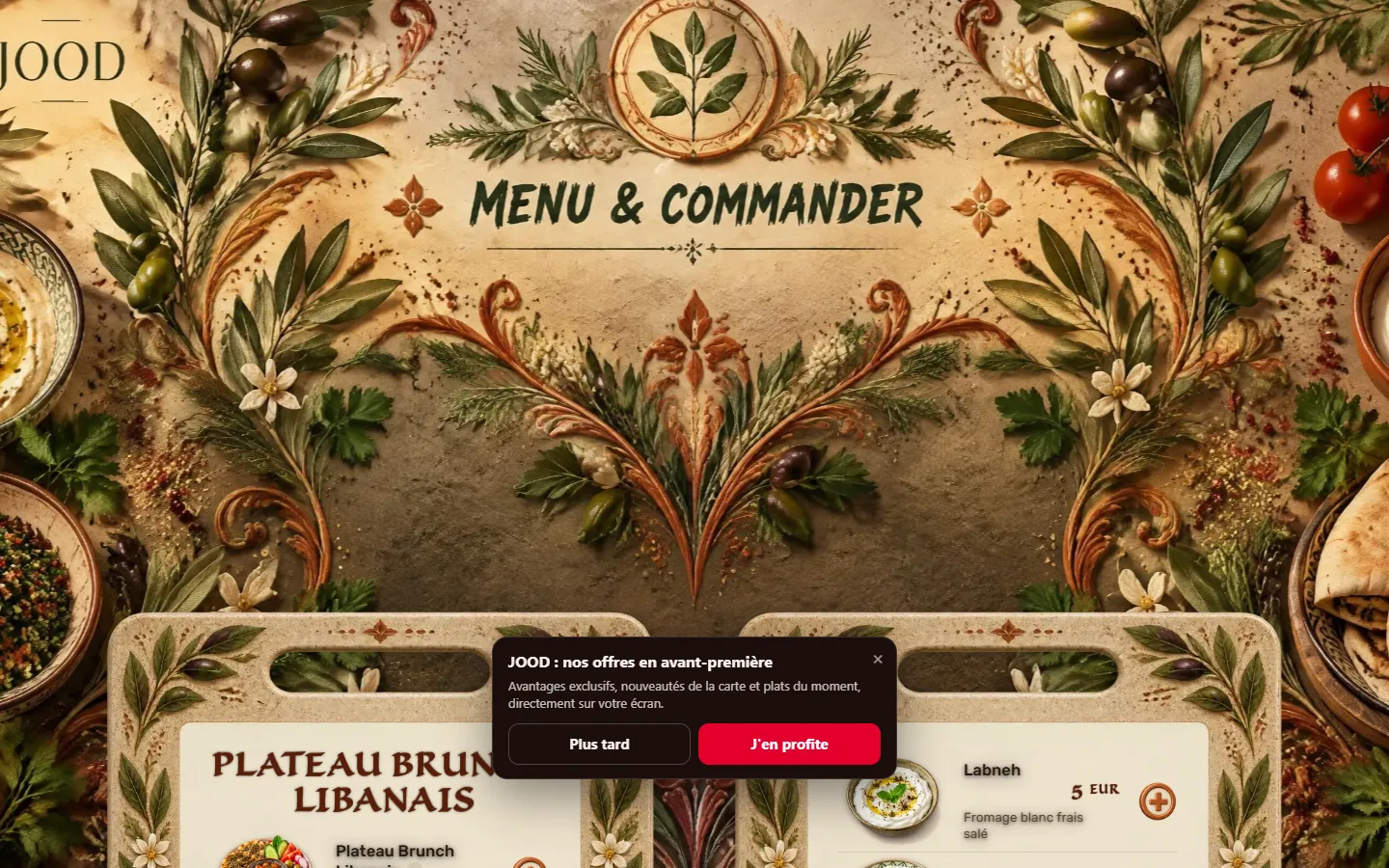
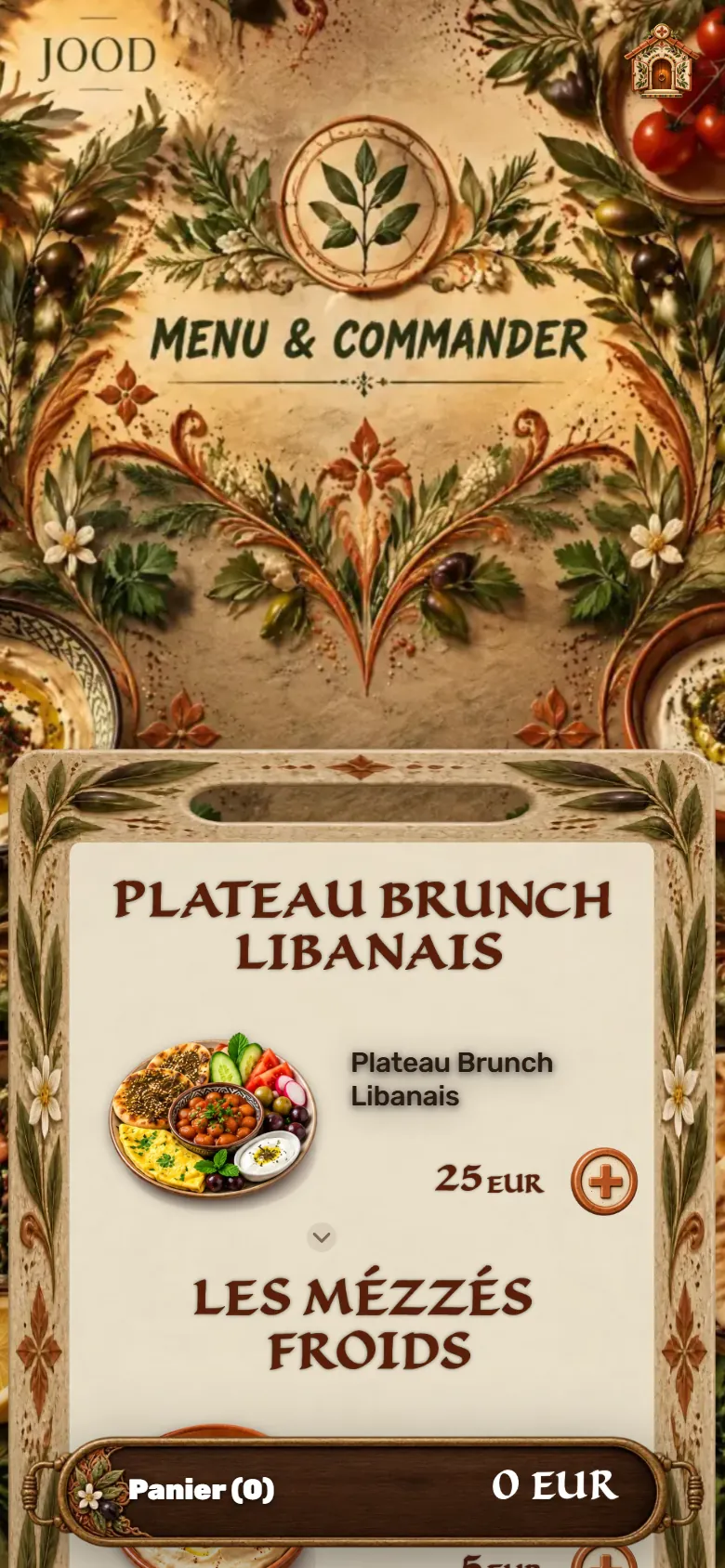
JOOD's menu: a few dishes
 JOOD's menu: a few dishes
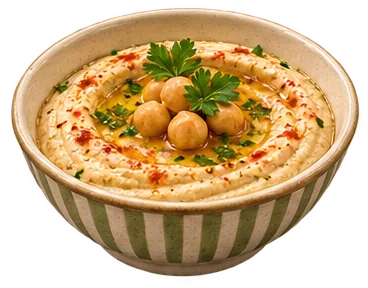
Dishes as they appear on JOOD's online menu, with the restaurant's own names, descriptions and prices.
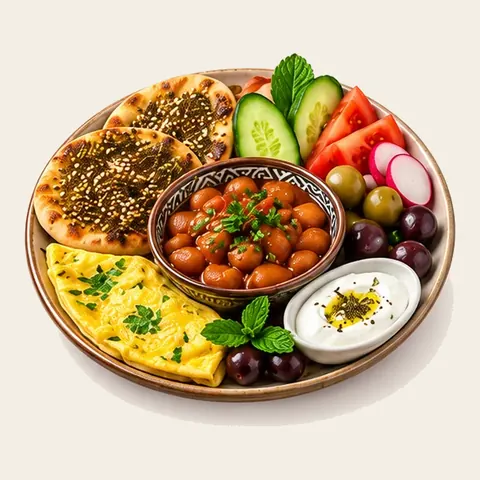 Plateau Brunch Libanais
Mini Man'ouche (galette zaatar, huile d'olive, menthe, tomate), Foul moudammas (fève & pois chiche, ail, citron, cumin, paprika, huile d'olive, oignon, tomate, taratour), Olives, Omelette mini (fromage haloumi ou zaatar fromage), Labneh (fromage fermenté & onc
€25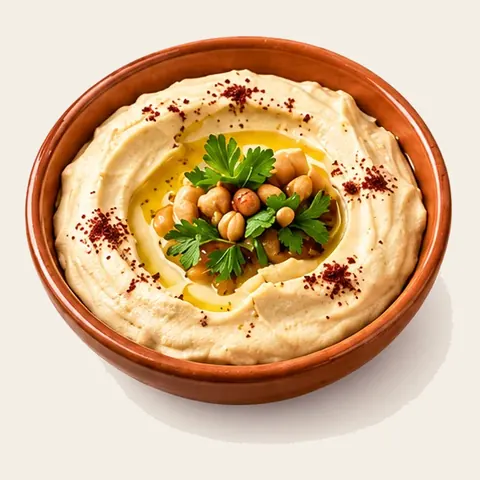 Les Mézzés Froids
Hommous
Purée de pois chiche, crème de sésame, citron
€5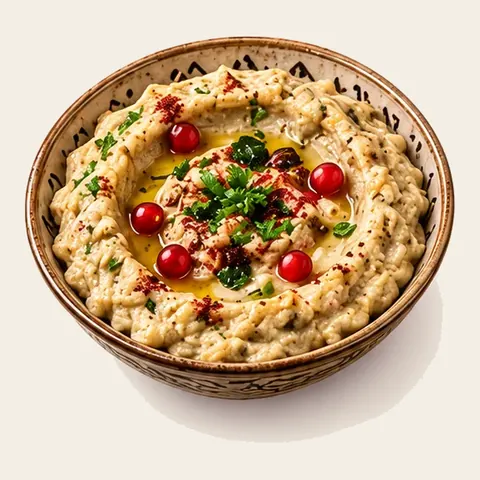 Les Mézzés Froids
Moutabal
Caviar d'aubergine fumée, crème de sésame
€5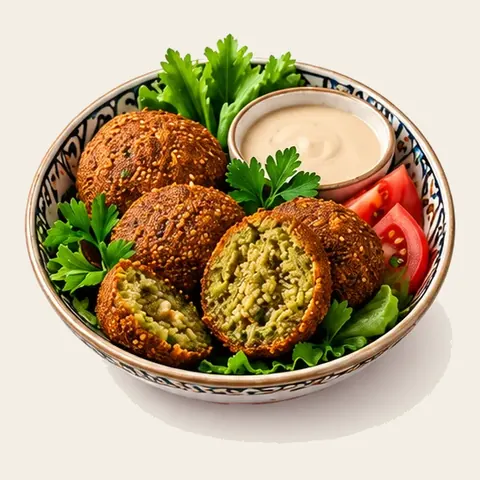 Les Mézzés Chauds
Falafel
Pois chiches, coriandre, ail, oignon, poivron, poireau, épices pour falafels, tahini
€10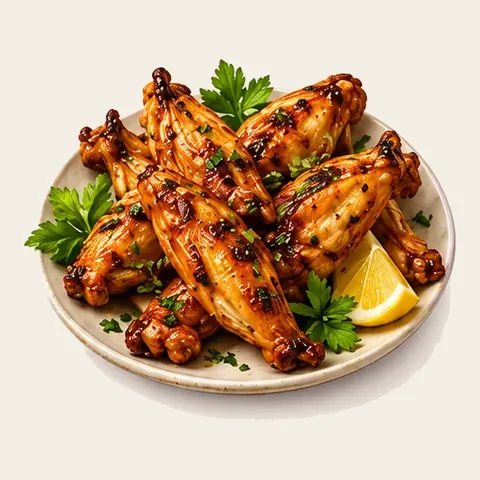 Viandes
Jawaneh
Aile de poulet marinée & grillée
€6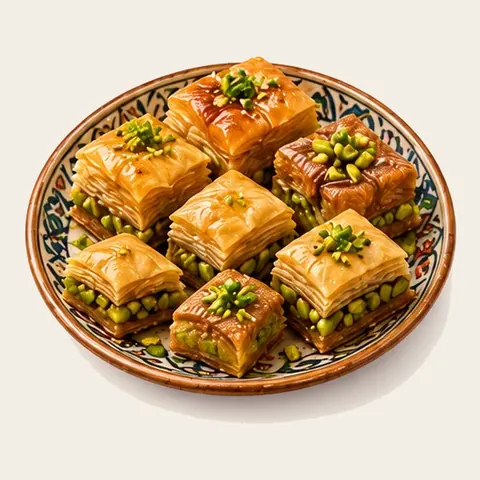 Desserts
Baklawa
Pignon de pain, noix de cajou et pistaches
€2- Boissons
Vin
Blanc / rouge / rosé
€7 - Boissons Chaudes
Café
€3 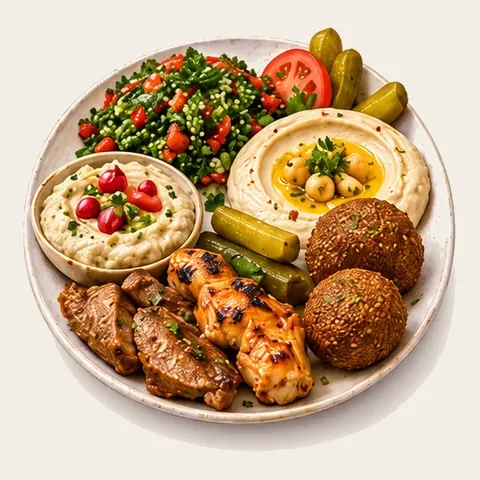 Formules
Formule Jood
3 mezzés - 1 falafel - 1 viande
€21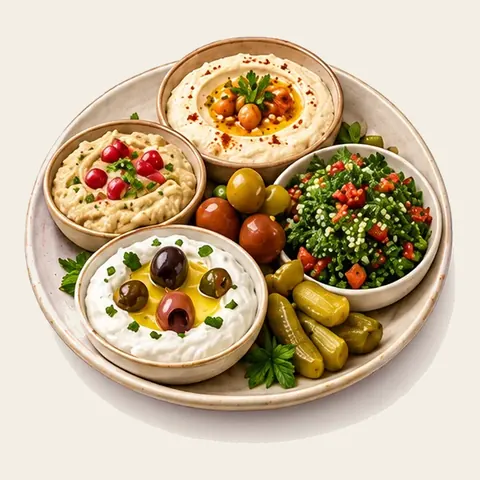 Sur Place
Mezzés sur Place
5€ la portion
€5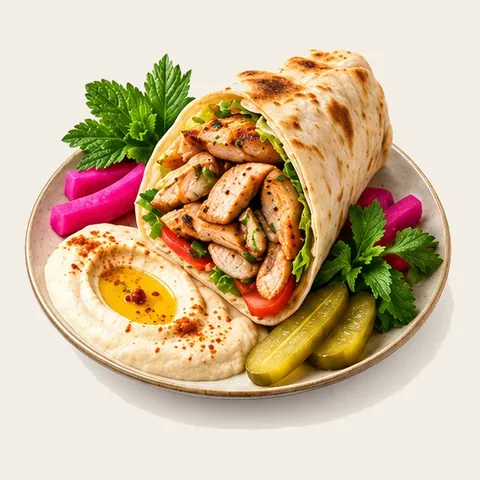 Sandwichs
Charwama Poulet
Houmous, crème d'ail, cornichon, salade
€10- Café et Thé Gourmands
Thé Gourmand
Une mini Man'oucha, une mini théière et 2 pâtisseries
€10


Designed for the phone as much as for the computer
 Designed for the phone as much as for the computer
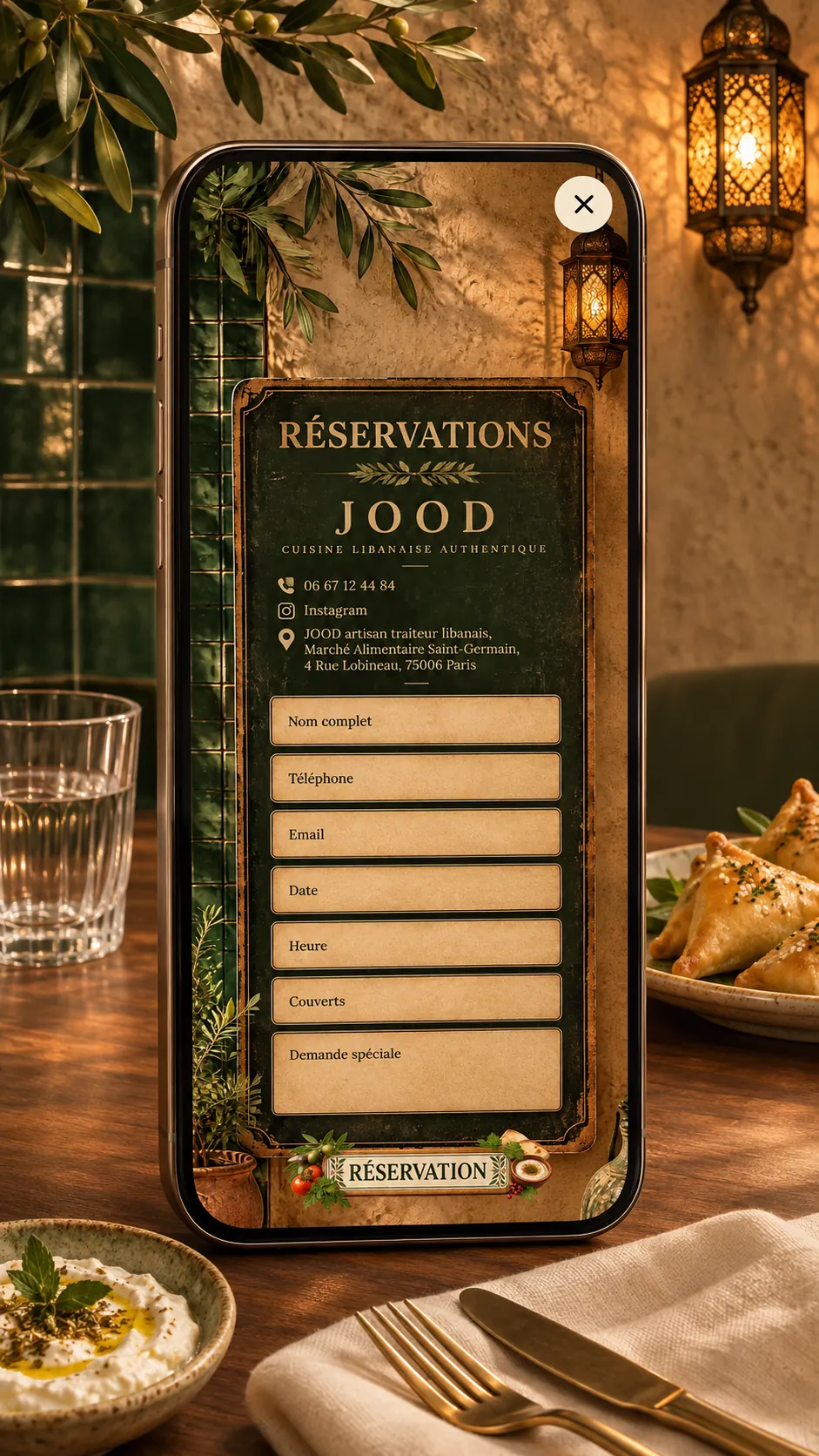
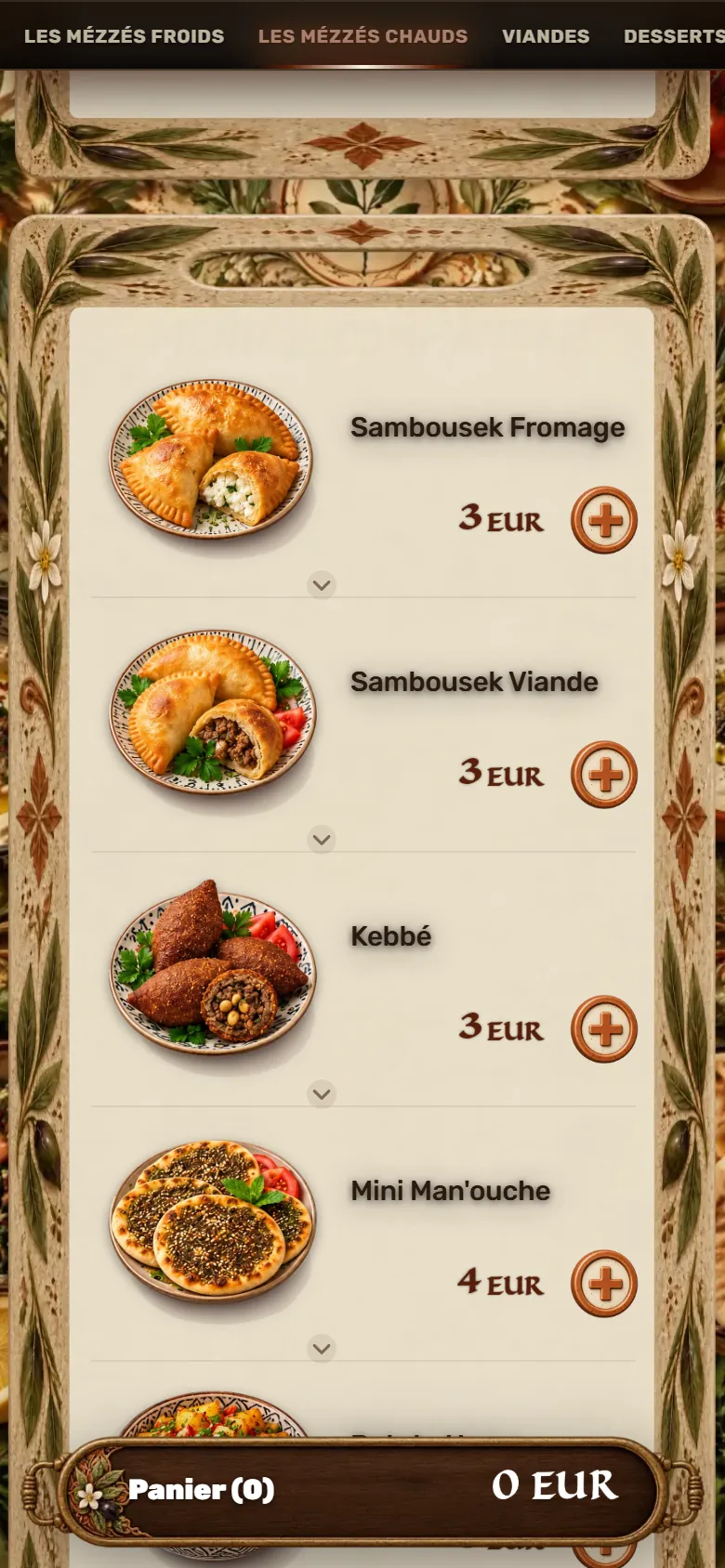
On a phone, the film rearranges itself vertically: the Commander button at the top, the name JOOD, the title “Venez goûter notre Liban.”, then a mezze signboard that fills the full width, above the small landscape. On the ordering page, the stone frames stack up, a small house-shaped button sits at the top right, and the cart bar, in dark wood decorated with a flower, stays fixed at the bottom of the screen.
A website prepared for local searches
 A website prepared for local searches
The site answers the searches people make in the sixth arrondissement: a Lebanese restaurant or simply a restaurant near Odéon, a brunch, an address for eating meat, a sandwich shop or a Lebanese sandwich, a meal to take away, vegetarian or vegan cooking, or directly the name JOOD. The page title, its description, its texts and its structured data present the caterer, its neighborhood, its cuisine and its menu with the same words.
A detailed presentation page complements the home page, and the full menu can be read as text on the ordering page. Nobody can promise a place on Google: the work consists of giving search engines accurate, structured and consistent information.

A website for a Lebanese caterer in Paris: take mezze orders online
A Lebanese caterer lives on trays people build themselves: cold mezze (hummus, moutabal, labneh), hot mezze (falafel, kibbeh, sambousek), shawarma, a brunch platter, baklava. A Lebanese caterer’s website in Paris should read like a counter and offer online ordering for takeaway or delivery, whether it is the office lunch or the evening meeting.
- A counter-sized budget: a craftsman in the Saint-Germain market hall has no use for an agency project; no quote to haggle over, and no commission on the trays ordered.
- From a name to a full menu in minutes: mezze, grills, sandwiches, set menus and drinks fall into place almost by themselves.
- A site that smells of the market: teal walls, pale wood, olive trees and ochre rocks, nothing like an interchangeable caterer template.
- Today’s tray, to the minute: the owner removes a sold-out mezze or adds a set menu from a phone, and the page follows.
- Nobody between kitchen and plate: the order reaches JOOD itself, not a delivery platform or an agency.
- Odéon or elsewhere: the same software serves a caterer in Lausanne, London, Rabat or Sydney, in the local language and currency, which matters for the district’s international customers.
For a Lebanese caterer or restaurant in Paris, Dineora builds a site that is shared the way mezze are shared.
Dineora in numbers: 0% commission on your orders · a website live in 5 minutes.
Learn more: Restaurant website builder · Online ordering system for restaurants · QR code menu for restaurants
The result: a Lebanese table in the middle of the market
 The result: a Lebanese table in the middle of the market
The JOOD website tells the story of a place in the heart of a market hall: a table between the stalls, mezze to share, generous Lebanese cooking. It does so in three chapters, then makes room for a clear menu, where you order in a few gestures for takeaway or delivery. That is what Dineora looks for in every website: that it looks like its restaurant, down to the way you order there.


The website in pictures
 The website in pictures
Screenshots of the live website, on a computer and on a phone.
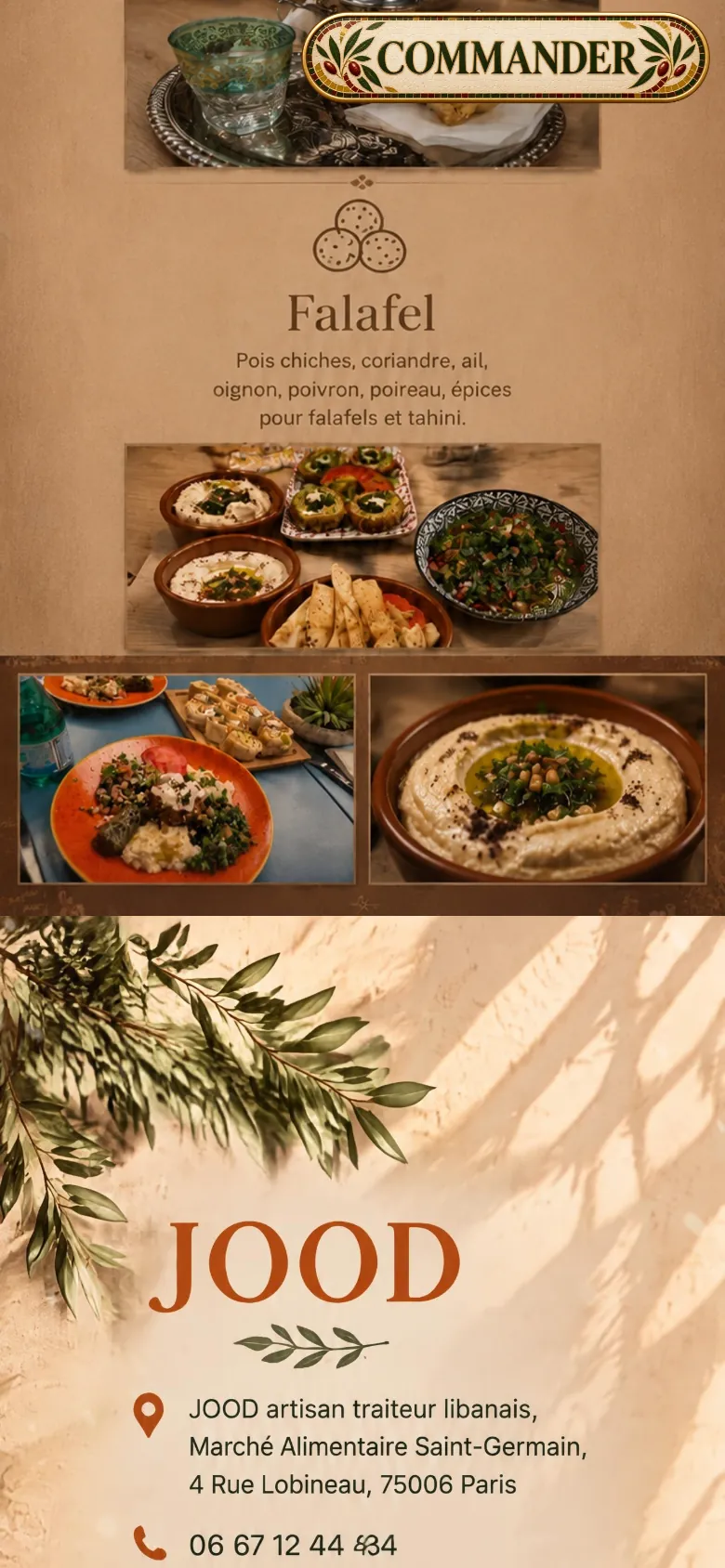
JOOD: practical information
 JOOD: practical information
- Address
- JOOD artisan traiteur libanais, Marché Alimentaire Saint-Germain, 4 Rue Lobineau, 75006 Paris
See the address on Google Maps - Cuisine
- Lebanese caterer and restaurant
- Services
- Online ordering for pickup · Delivery
- Menu sections
- Plateau Brunch Libanais · Les Mézzés Froids · Les Mézzés Chauds · Viandes · Desserts · Boissons · Boissons Chaudes · Formules · Sur Place · Sandwichs · Café et Thé Gourmands
- The restaurant's website
- dineora.io/jood-paris
 Menu sections
Questions about this project
 Questions about this project

Who designed the website of JOOD?
The JOOD website was designed by Dineora: art direction, a home page built as a film, an online menu and an ordering page for takeaway or delivery.
Can you order from JOOD online?
Yes. The Commander button leads to the whole menu, from mezze to desserts: you add your dishes to the cart, then choose pickup or delivery.
Where is JOOD in Paris?
JOOD is an artisan Lebanese caterer located in the hall of the Saint-Germain market, in the Odéon neighborhood, in the sixth arrondissement.
How can a Lebanese caterer sell trays online without a delivery platform?
The caterer’s own site shows the menu and takes takeaway or delivery orders itself. They reach the business directly, and Dineora takes no commission on them.
Does a caterer need a developer to put a mezze menu online?
No. The owner gives the name of the business: menu, visuals and ordering pages are generated, and prices, dishes or opening hours can then be changed by the owner at any time.
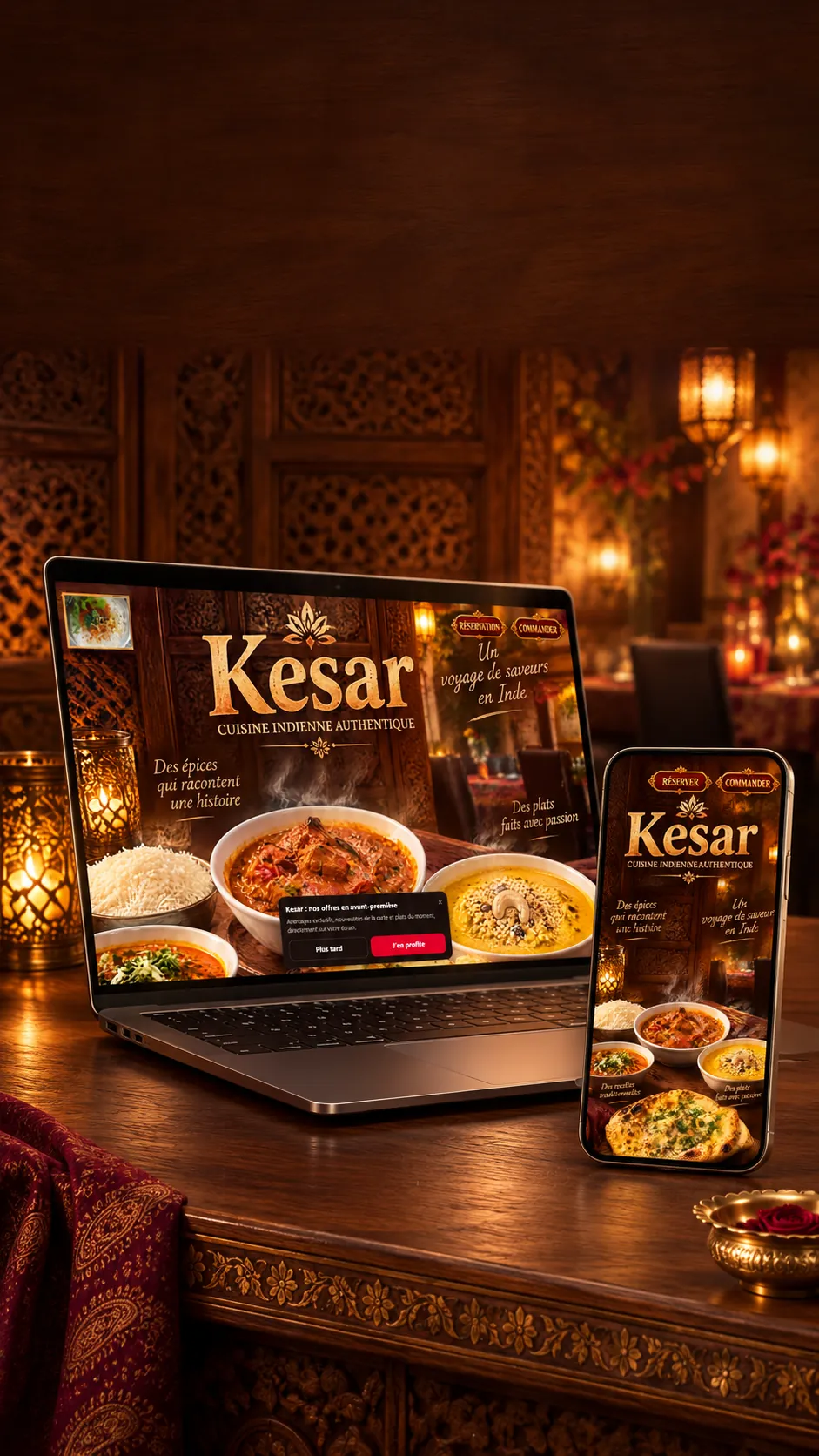 Kesar
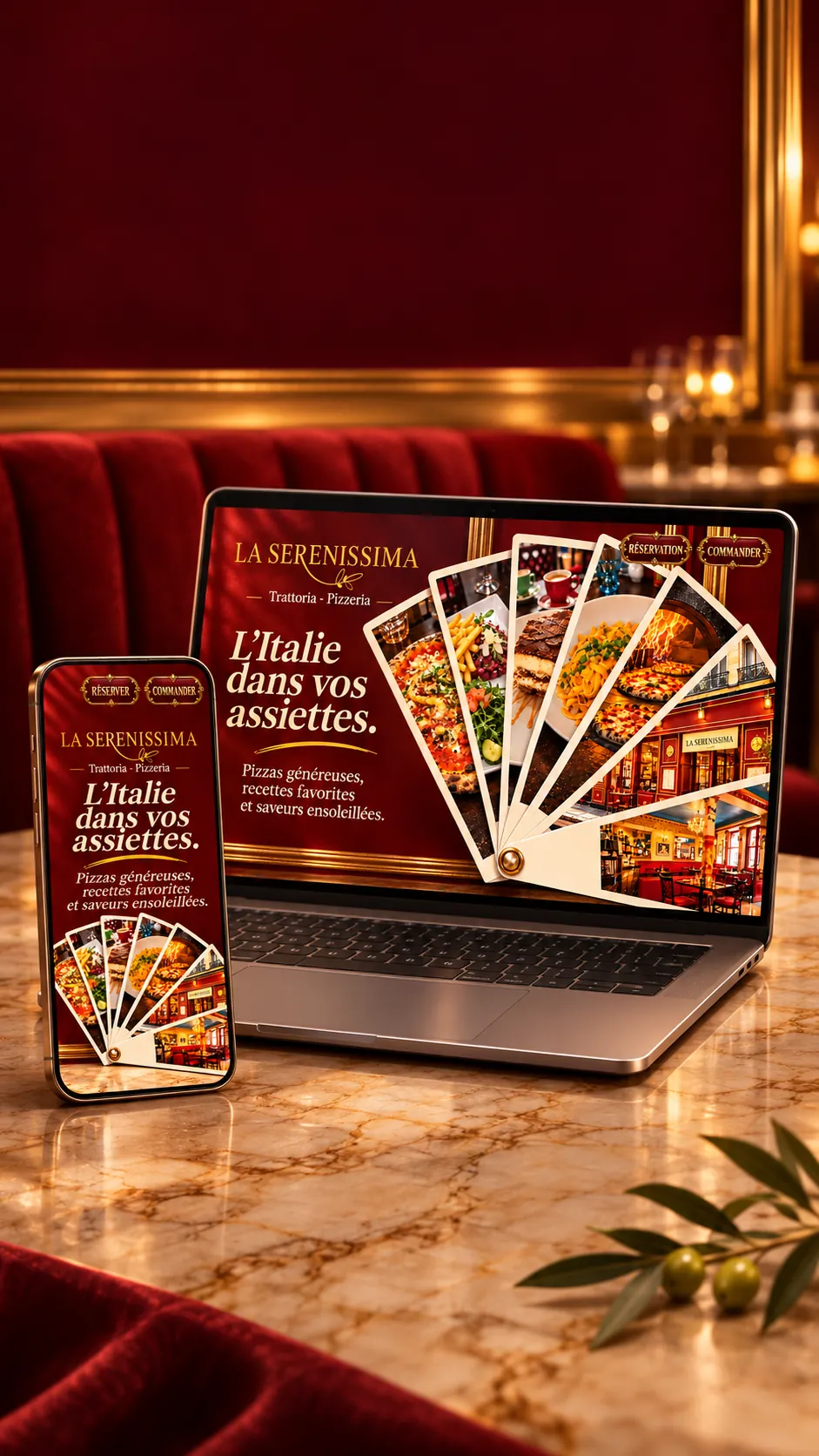 La Serenissima
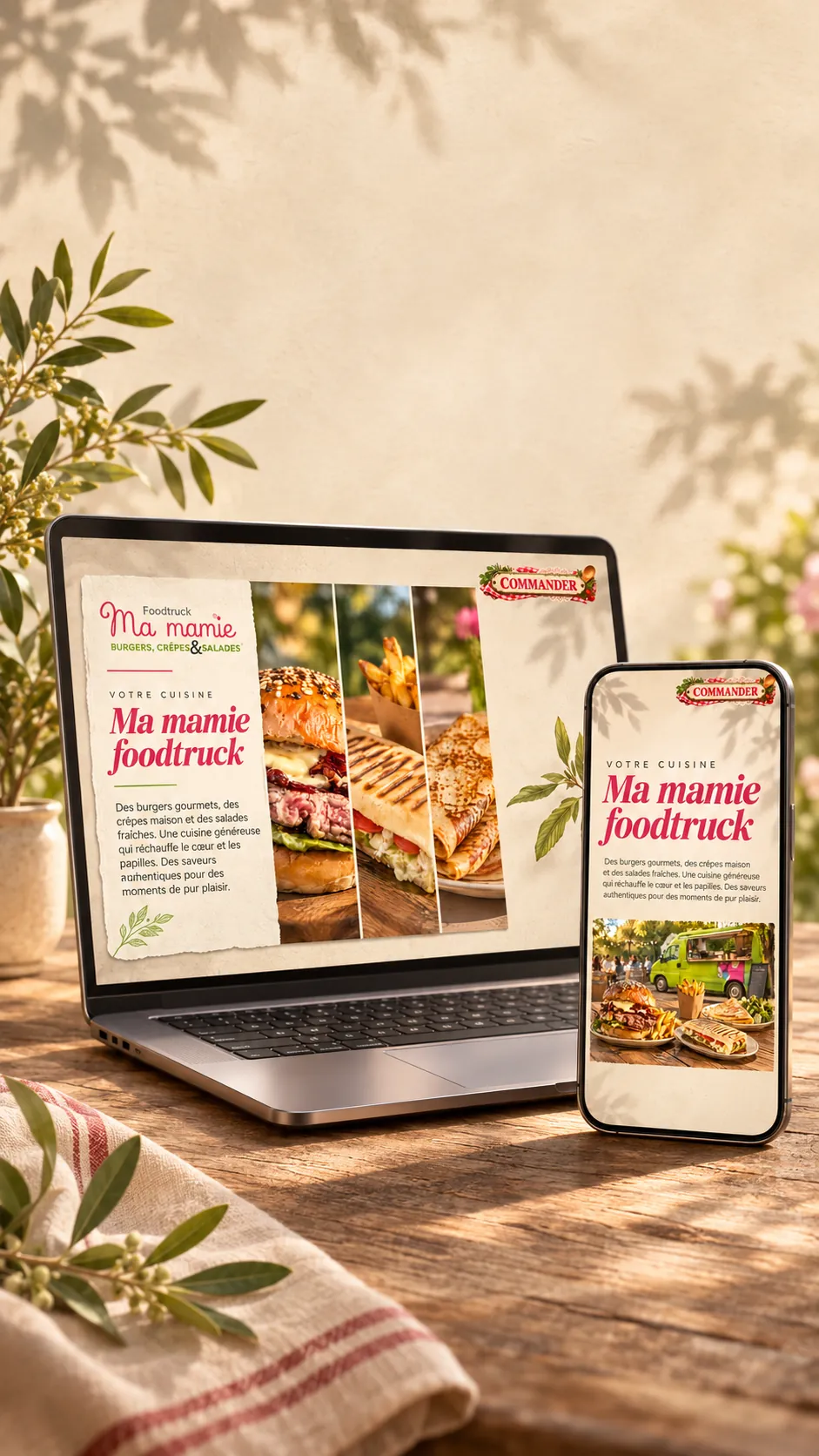 Ma mamie foodtruck
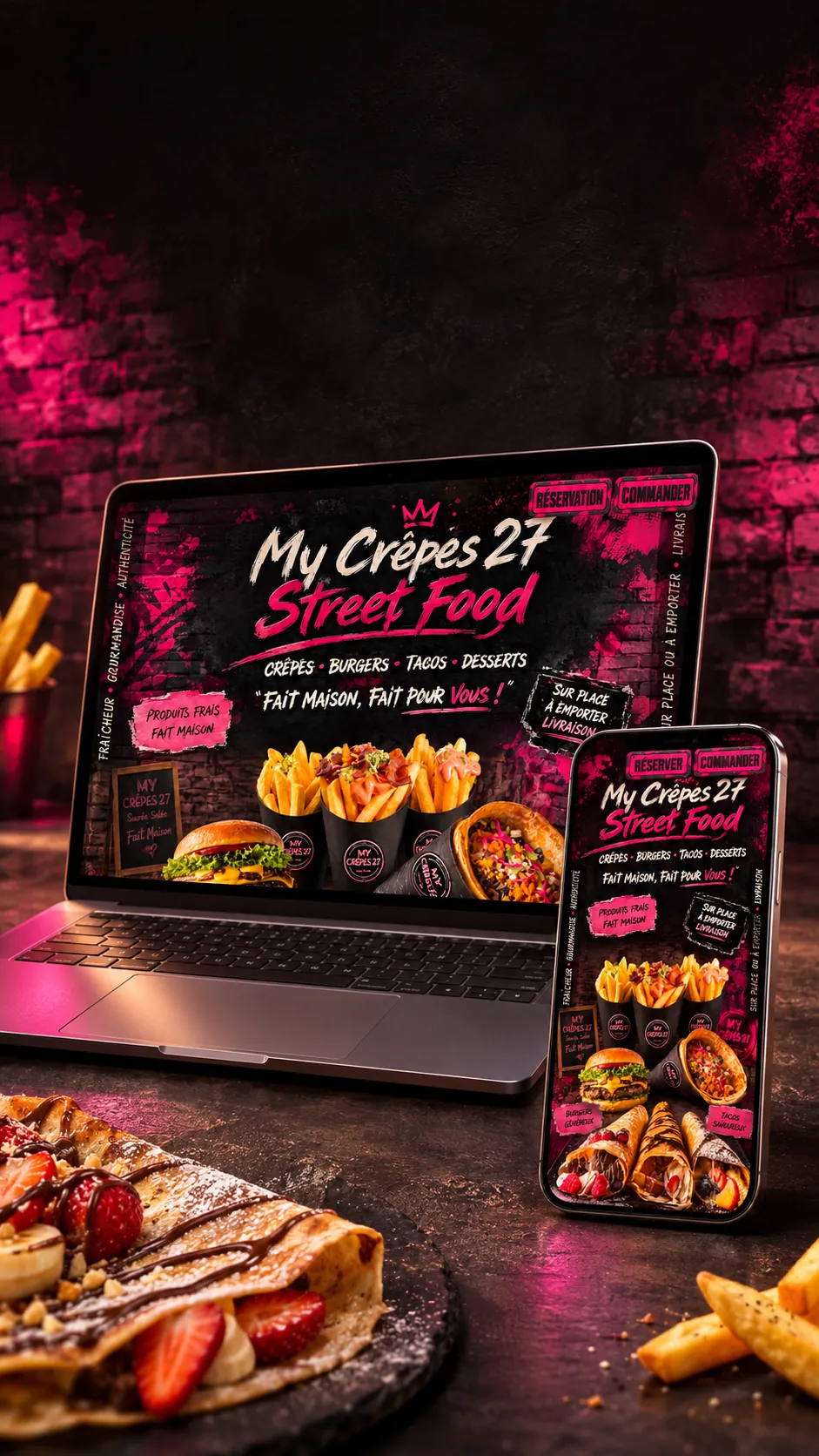 My Crêpes 27
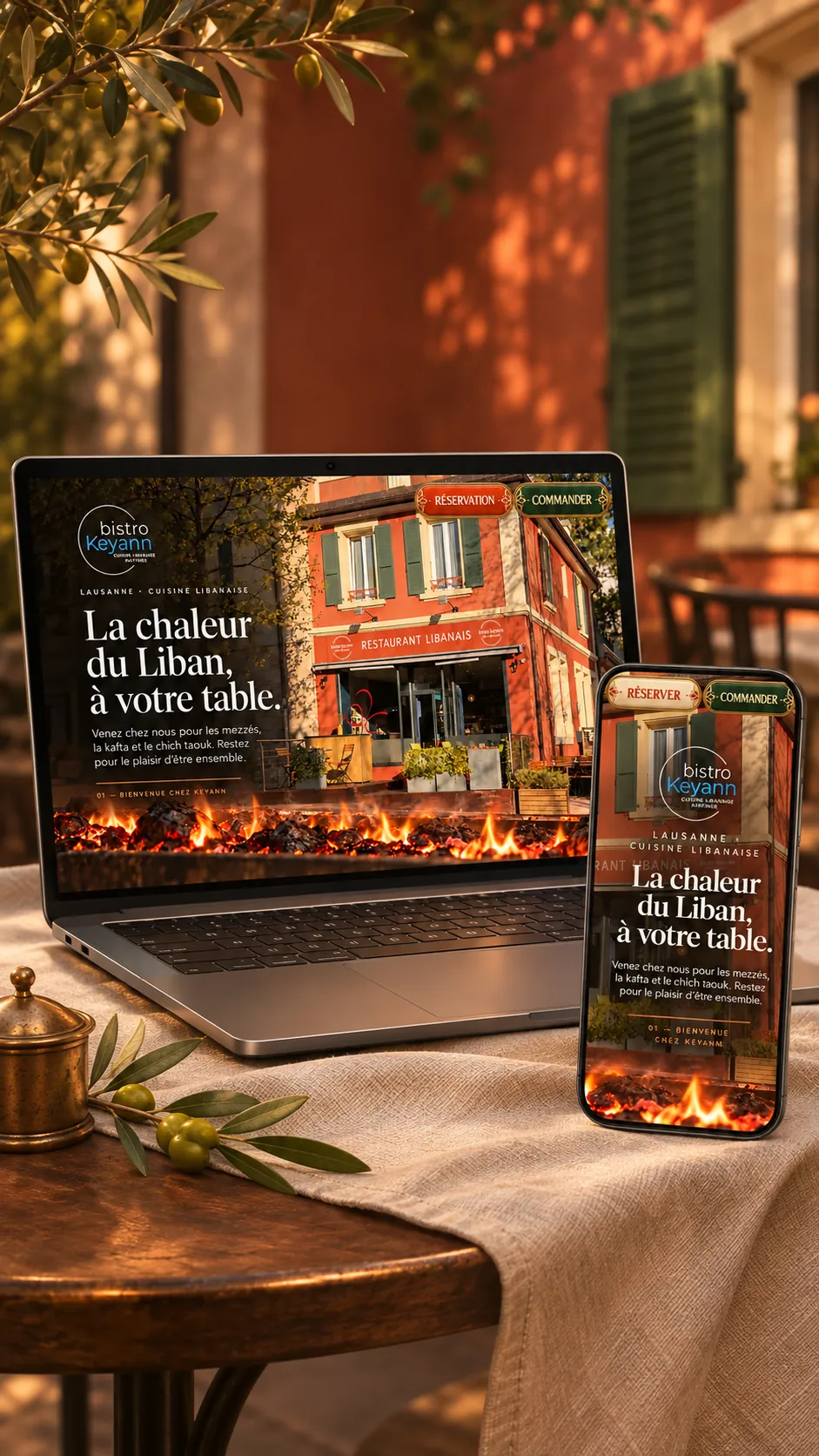 Keyann Bistro Libanais
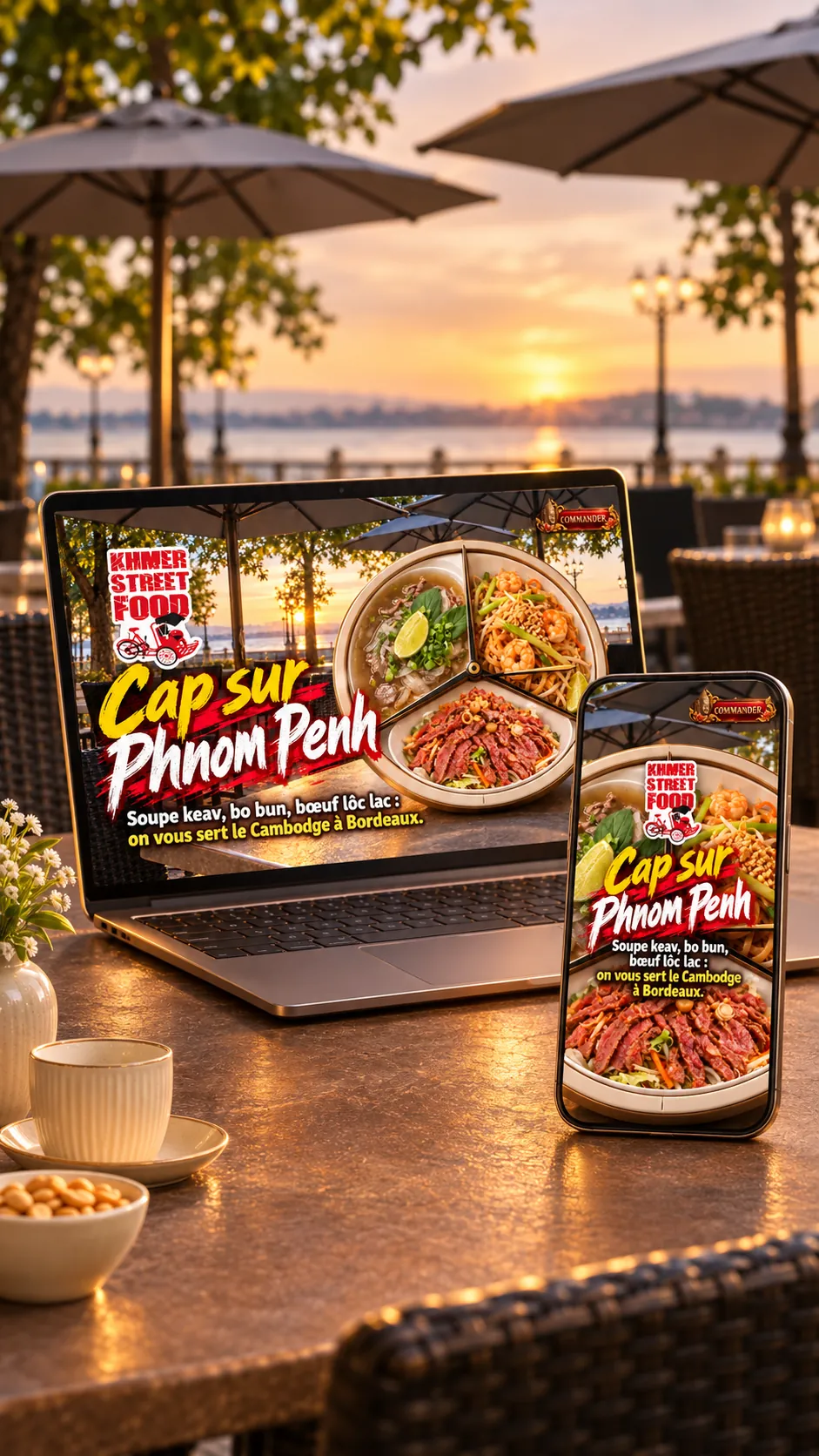 Khmer Street Food
